
What Length Clip-In Extensions Should You Get?
Choose clip-in extension length by your current hair length and the look you want. A simple chart for 16, 20 and 24 inch sets, plus how to measure at home.
Journal / Clip-ins
Everything first-time buyers ask about clip-in extensions: how they work, shade, length, grams, how to put them in, whether they damage hair, and how long they last.
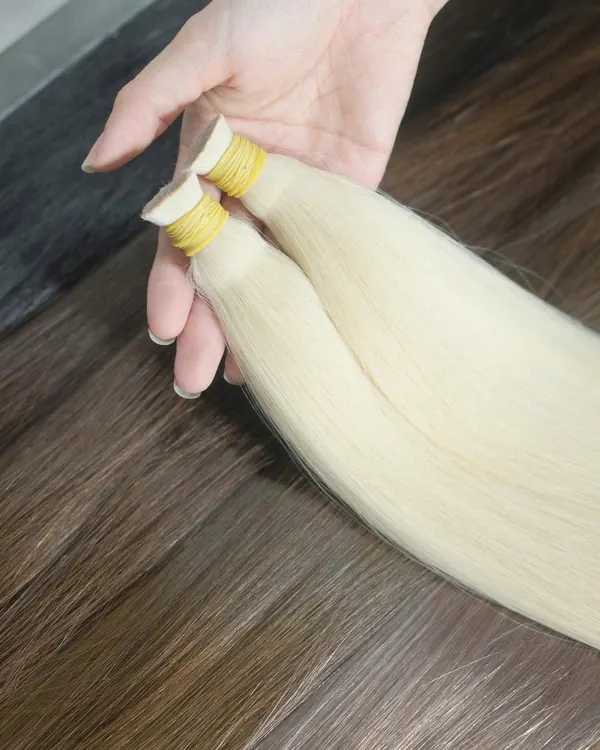
Clip-in extensions are the most popular way to add length and volume without a salon. You clip them in when you want them and take them out at night, which is why most people start here. Most of what first-time buyers worry about comes down to five choices: shade, length, weight, texture and how to put them in.
In short: clip-in extensions are wefts of hair with small snap clips sewn along the top. You clip them close to the roots in horizontal sections and let your own hair fall over them. To get a natural result, match the shade to your ends, choose 4 to 8 inches longer than your hair, and pick a weight your hair can cover.
Clip-in hair extensions are sections of hair, called wefts, sewn onto a narrow strip with small pressure clips attached. A full set usually has several wefts of different widths: wider ones for the back of the head, narrower ones for the sides.
Our clip-in set has 7 wefts, 140g of single-donor human hair, in 16, 20 or 24 inches, straight or wavy.
Clip-in extensions suit anyone whose own hair is about chin length or longer and who wants more length, more volume, or both, without a long-term commitment. They are popular for:
If your thinning is concentrated at the crown or part, a topper covers that area better than clip-ins. Our beginner’s guide to at-home hair extensions compares all the options.
Choosing a clip-in set comes down to four decisions, in this order.
| Decision | What to match | Our guide |
|---|---|---|
| Shade | The ends of your hair, in daylight | How to match extensions to your hair color |
| Shade number | The closest code on the chart | Hair color numbers explained |
| Length | 4 to 8 inches longer than your hair | What length clip-ins to get |
| Weight | How much hair you have now | How many grams of clip-ins you need |
Texture is the fifth: choose straight or wavy to match how you usually wear your hair, since human hair can be restyled with heat if you change your mind on the day.
Putting in clip-ins takes about 5 to 15 minutes, starting at the back and working up.
If a clip slides on silky or fine hair, tease the section lightly at the root before clipping for extra grip.
Clip-ins look natural when three things are right: the shade matches your ends, the weight is one your hair can cover, and the top weft sits low enough for your own hair to fall over it. The most common giveaways are a shade that is one step too light and a set too heavy for fine hair, which shows at the edges of the wefts.
Clip-in extensions are among the gentlest types, because they come out every night and use no glue or heat. They are not completely risk-free. The small sections of hair the clips grip carry the weight of the set, so very heavy sets, clips placed on tiny sections, and wearing them to bed can stress those strands over time.
Three habits keep the risk low: choose a weight that suits your hair, place clips on sections at least as wide as the clip, and shift the clip positions slightly from day to day.
Human hair clip-ins often last a year or more with regular wear and good care, although lifespan depends on how often you wear them, how you wash them and how much heat you use. Washing only when needed, using a heat protectant and storing them flat or hanging all help them last.
Care for clip-ins much like your own hair, but more gently:
Send a daylight photo of your hair through our contact page and we will reply with the shade, length and weight we would choose. Our clip-in sets are made to order and available in our Etsy shop. If you usually wear your hair up, our guide to ponytail extension types may suit you better.
Yes. Clip-in extensions are one of the easiest types to start with, because nothing is glued or bonded and you can take them out at any time. Most beginners take about 15 minutes the first time and get under 10 minutes after a few tries. A set with fewer, wider wefts is quicker to learn.
It is best not to. Sleeping in clip-ins puts pressure on the clips and the hair they grip, and the extensions tangle against the pillow. Take them out before bed, brush them, and store them flat or hanging so they are ready for the next day.
You can wear clip-ins daily, but give your own hair a break when you can and vary where the clips sit slightly each time, so the same strands are not holding the weight every day. Take them out before sleeping, swimming or heavy exercise.
Clip-ins are among the gentlest extensions when the set suits your hair, but they are not risk-free. Repeated tension from heavy sets, clips placed on very fine sections, or wearing them overnight can stress the hair at the clip points. Choosing the right weight and placing the clips well keeps the risk low.