
Hair Color Numbers Explained: Find Your Shade (#1B, #2, #613)
What hair extension shade codes like #1, #1B, #2, #4, #27, #60 and #613 mean, why they differ between brands, and how to find the number closest to your hair.
Journal / Shade & color
Match extensions to your hair at home: which part of your hair to compare, how to photograph it in daylight, and what to do if you fall between two shades.
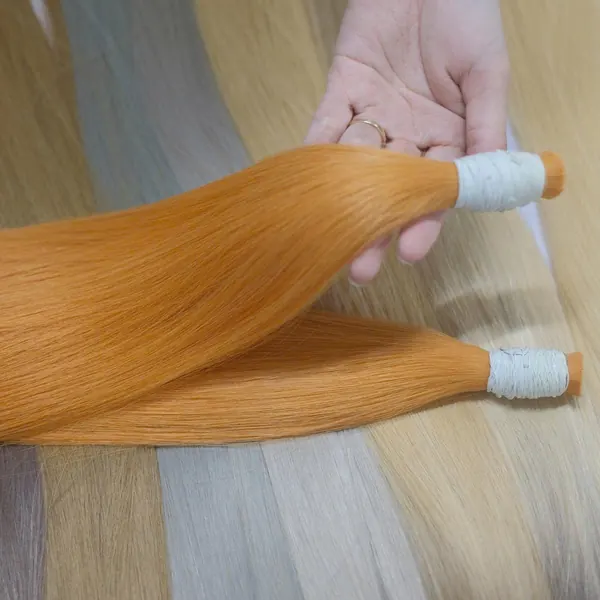
Shade is the one choice that decides whether extensions blend in or stand out. A perfect length and weight will not rescue a piece that is a shade too light, and because made-to-order hair cannot be sent back for a change of mind, the match is worth getting right before you order.
In short: match hair extensions to the ends of your hair, in natural daylight, with no flash or filters. Compare against a shade chart or the actual hair, and if you fall between two shades, choose the darker one for a solid color or blend two shades for highlighted hair. A daylight photo is enough for us to match your shade for you.
Match the mid-lengths and ends of your hair, not the roots or the top layer. Clip-ins and ponytails sit in the lower half of your head, so the hair they touch is the hair around your ears and below. That hair is usually lighter than your roots because of sun, washing and heat styling.
Hold a section from the back of your head, below the crown, and look at it from mid-length to the ends. That is the color your extensions need to meet.
Check your hair color in natural daylight, because indoor light shifts how color looks. Warm bulbs make hair look more golden and red, and cool LED light can make brown hair look ashier than it is.
Follow these steps:
The white paper gives a reference point, so we can see whether the photo has shifted warm or cool and read your true shade.
A shade chart is a guide to get close, not a final match. Extension brands use numbers such as #1B, #4 or #613 on a dark-to-light scale, but the same number can look different between brands. Our guide to hair color numbers explains what each common code means.
Use the chart to narrow your hair down to two neighboring shades, then compare those two against your hair in daylight or send us your photo.
Choosing between two shades comes down to how your own hair is colored.
| Your hair | Best approach | Why |
|---|---|---|
| One solid color | Choose the darker of the two | Darker reads as natural depth; lighter looks like a stripe |
| Highlights or balayage | Blend two shades in one set | Mixing strands copies the dimension in your hair |
| Darker roots, lighter lengths | Match the lengths | The roots stay covered by your own hair on top |
| Grey or going grey | Ask about a custom blend | Grey needs matching by the share of grey, not a single number |
Match undertone as well as depth. Two browns at the same depth can still clash if one is warm and golden and the other is cool and ashy.
A quick way to read your undertone: in daylight, warm hair shows gold, copper or red, and cool hair looks smoky, beige or silvery. Our #27 honey blonde is a warm shade, for example, while our #18 ash blonde and #60 platinum are cool.
Texture changes how color reads, so match it along with the shade. Wavy hair creates small shadows and looks slightly darker than the same shade worn straight. If your hair is naturally wavy but you straighten it most days, compare your extensions against your hair the way you usually wear it.
A small difference can usually be fixed. Human hair can be toned or colored by a stylist, and placing the wefts a little lower, where your own hair covers more of them, softens a slight mismatch. Because we make every piece to order, we match the shade with you before we start, which is the best way to avoid a mismatch in the first place.
Send a daylight photo of your hair through our contact page, taken the way described above, and we will reply with the shade we would choose and why. Once you know your shade, our complete guide to clip-in extensions and our guide to ponytail extension types help you pick the right piece, available in our Etsy shop.
Match your extensions to the ends of your hair, not the roots. Extensions sit in the lower half of your head, next to your mid-lengths and ends. Your roots are usually darker and stay covered by the hair on top, so matching the roots tends to give extensions that look too dark.
Choose the darker shade if your hair is mostly one solid color, because a slightly darker extension reads as natural depth while a lighter one stands out. If your hair has highlights or grown-out color, blending two shades in one set usually works better than picking either one alone.
Yes, if the photo is taken in daylight without flash or filters. Stand facing a window, hold a section of hair from the back of your head, and include a white sheet of paper in the shot so the true color can be judged. Photos under indoor lighting usually make hair look warmer or darker than it is.